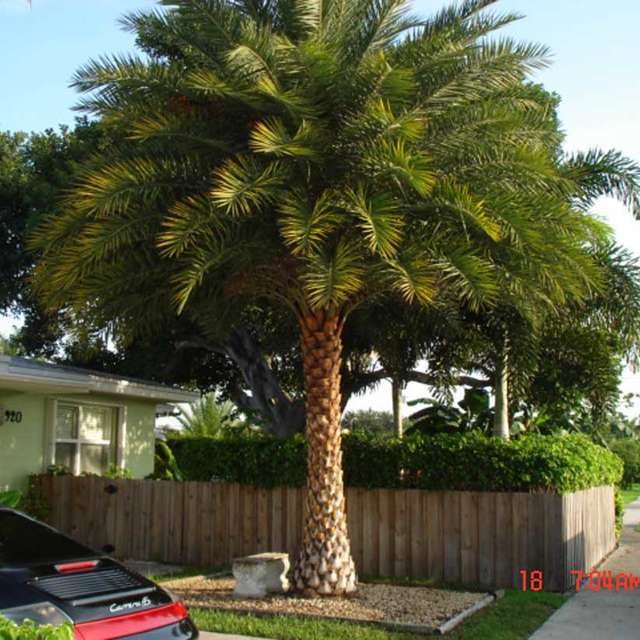
Yes — the Sylvester palm’s single, flexible trunk and crown structure let it bend rather than break in high wind, which is a big part of why it’s a common choice for coastal and hurricane-prone Florida landscapes, alongside its cold-hardiness and disease resistance. That said, real storm performance also depends on how well the palm was planted and how established its root system is, not on species alone.
Why Are Palms More Wind-Resistant Than Broad-Canopied Trees?
A palm’s growth habit is fundamentally different from a broad-canopied hardwood. Instead of a wide branching structure that catches wind across many rigid limbs, a palm grows a single trunk topped by a crown of fronds that can flex and move as a unit. That flexibility is a large part of why palms, as a category, generally handle sustained wind better than trees built around a wide, stiff branch structure — the same wind load has fewer rigid points to concentrate stress on. A broad-canopied tree with heavy, rigid limbs has more surface area fighting the wind instead of moving with it, which is where a lot of storm damage to landscape trees actually originates.
How Does the Sylvester Palm’s Structure Handle Wind?
The Sylvester palm — Phoenix Sylvestris — carries this same palm growth pattern, and the Robusta variety we grow adds a larger caliper trunk on top of it. A thicker trunk generally means more substance to work with structurally, which is one reason the variety holds up well in high winds once it’s established in the ground. The crown itself moves and flexes in wind rather than resisting it rigidly, which is normal behavior for the species and not a sign of a problem.
Does Planting Depth and Establishment Affect Storm Performance?
Species characteristics only tell part of the story. How a palm is planted matters just as much. Planting at the correct depth — never deeper than the palm was grown in the field — and giving it a proper watering-in schedule during the first two weeks gives the root system the best chance to reconnect with the surrounding soil. A palm with a well-established root system sits more securely in the ground than one that’s still working through its establishment period, regardless of species. See our full planting and care guide for the complete process.
Is the Sylvester Palm a Good Fit for Coastal Landscapes?
Between its wind tolerance, cold-hardiness below 20°F, and disease- and pest-resistance, the Sylvester palm checks a lot of boxes for landscapes in coastal and storm-prone parts of Florida. It’s not a guarantee against damage in every storm — no tree is — but the combination of a flexible growth structure and genuine durability across multiple stress factors is why landscape designers and homeowners in our area keep coming back to it for entrances, focal points, and property-line plantings. Field-grown specimens, like the ones we grow here in Vero Beach, also tend to develop a more natural root structure than containerized palms, which supports that stability over the long term.
What Can You Do to Prepare a Newly Planted Palm for Storm Season?
If you’re planting ahead of storm season, timing and aftercare matter. Give a new palm as much establishment time as possible before peak season, follow the watering schedule closely during those first critical weeks, and make sure it was planted at the right depth from the start. Beyond that, general storm prep — clearing loose debris nearby, checking that nothing is bound too tightly against the trunk — applies the same way it would to any tree on the property. If you’re not sure how much lead time your planting timeline realistically allows before the season picks up, that’s a good question to bring directly to the farm when you call.
Choosing a Wind-Tolerant Palm for Your Property
If wind tolerance is a priority for your landscape — whether you’re near the coast, on an open lot, or just want a palm that won’t need to be replaced after the next storm — the Sylvester palm is worth a close look. Come walk the rows at the farm to see specimens in person, browse sizes and grades on The Palms page, or read how the species compares to other date palms on the market in our Sylvester vs. Canary Island vs. Medjool post.
Frequently Asked Questions
Do Sylvester palms lose their fronds in high wind?
Some frond movement and occasional frond loss is normal for any palm in sustained high wind. The trunk and crown of an established Sylvester palm are built to flex through that movement rather than fail structurally, which is different from losing a few older fronds.
How long does a Sylvester palm need to establish before a storm?
The first two weeks after planting are the most critical establishment window, and root development continues well beyond that. A palm planted with proper depth and watered on schedule is in a stronger position heading into storm season than one planted hastily right before it.
Are field-grown Sylvester palms different from containerized palms in wind?
Field-grown palms develop a more natural, extensive root structure over their years in the ground compared to containerized palms, which is part of why landscape designers and arborists often prefer field-grown specimens for permanent plantings.
Should I stake a newly planted Sylvester palm before a storm?
Staking support during the establishment window is a common practice for newly planted palms and is worth discussing directly with the farm for your specific site and planting timeline, since the right approach depends on the individual palm and location.